Growth vs Value Stocks Understanding the Key Differences for Smart Investing
Finance
|
April 9, 2026
When investing in the stock market, one of the most common questions investors face is whether to focus on growth stocks or value stocks. Each approach represents a different investment style, with unique risks, potential returns, and long-term strategies.
When investing in the stock market, one of the most common questions investors face is whether to focus on growth stocks or value stocks. Each approach represents a different investment style, with unique risks, potential returns, and long-term strategies.
Growth stocks typically represent companies expected to expand their earnings at an above-average rate, which often leads to higher valuations. Value stocks, on the other hand, are companies that may appear undervalued based on their fundamentals, often trading at lower price-to-earnings ratios compared to the broader market.
Understanding the differences between growth and value investing is essential for building a portfolio that aligns with your financial goals, risk tolerance, and investment timeline. This article breaks down both approaches to help you make more informed investment decisions.
What Are Growth vs Value Stocks?
Growth stocks are characterized by their significant potential for earnings and rapid expansion. Companies like Amazon and Tesla are prime examples, prioritizing the reinvestment of profits into developing innovative products and expanding their market share. These firms typically showcase impressive revenue increases but may not pay dividends since profits are directed towards growth-oriented initiatives instead of returning cash to shareholders. This approach engages investors looking for substantial long-term capital appreciation.
Contrarily, value stocks embody a different investment philosophy, focusing on identifying companies deemed undervalued relative to their actual worth. These stocks reflect solid fundamentals, but trade at prices lower than what their intrinsic value suggests. Companies such as Ford and General Motors illustrate this category, where their reliable earnings, valuable assets, and regular dividends attract investors who seek bargains in the market. This strategy exploits market inefficiencies by emphasizing high-quality companies available at discounted prices.
The fundamental difference between growth and value stocks hinges on their respective investment philosophies. Growth investors emphasize companies with promising future growth prospects, whereas value investors concentrate on undervalued stocks possessing strong fundamental qualities. Recognizing this differentiation aids investors in selecting the most suitable stocks aligning with their financial objectives and risk tolerance, ultimately enhancing their investment strategies.
Key Differences Between Growth and Value Stocks
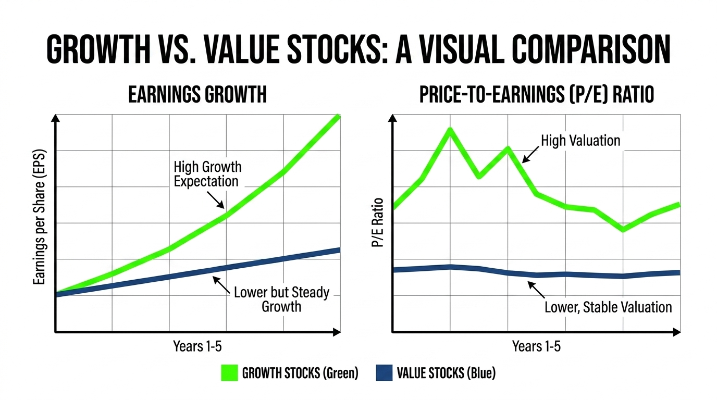
To navigate the stock market effectively, comprehending the distinctions between growth and value stocks is vital for making well-informed investment choices. One fundamental difference pertains to earnings expectations. Growth stocks are typically anticipated to exhibit earnings growth at a far superior rate compared to the overall market, favoring the reinvestment of profits instead of distributing them to shareholders. Alternatively, value stocks typically portray more stable earnings profiles, often featuring consistent dividends that appeal to investors seeking reliability.
A second prominent area of divergence is market valuation. Investors frequently utilize Price-to-Earnings (P/E) ratios to assess these stocks. Growth stocks generally possess higher P/E ratios reflecting their anticipated growth trajectories, implying that investors are willing to pay a premium based on presumed future earnings. In contrast, value stocks usually exhibit lower P/E ratios, indicative of perceived undervaluation in the market, thus signaling opportunities for investors searching for bargains.
Consideration of the risk profile is yet another crucial factor. Growth stocks tend to be more volatile, experiencing significant price fluctuations based on shifting market sentiment, which translates to increased risk. In comparison, value stocks are typically more stable, often considered safer investments owing to their established earnings base. This stability attracts conservative investors or those averse to market turbulence.
Growth vs Value Stocks: Pros and Cons
Growth Stocks
- High Return Potential: Growth stocks frequently align with companies anticipated to expand at an above-average rate relative to their sector or overall market, paving the way for potentially significant capital gains.
- Market Sentiment: Positive sentiment surrounding innovative companies can bolster demand, often driving up stock prices when strong growth narratives materialize.
- Reinvestment Opportunities: Many growth-centric firms prioritize reinvesting earnings into expansion and innovation, fostering compounding returns over the long term.
Value Stocks
- Steady Returns: Value stocks tend to emerge from established firms trading at lower valuations, presenting opportunities for stable, long-term gains that are more insulated from high volatility.
- Lower Price-to-Earnings Ratios: Investors often encounter value stocks characterized by favorable metrics like low P/E ratios, which suggest potential undervaluation and a safety margin.
- Dividends: A significant advantage of many value stocks is their consistent dividend payments, yielding regular income that supplements overall returns.

Which Is Better: Growth or Value Stocks?
Determining whether growth or value stocks represent superior investments relies heavily on several personal factors. Risk tolerance is critical; growth stocks offer higher potential returns but involve increased volatility, attracting those willing to accept greater levels of risk. Conversely, value stocks generally represent a safer bet for those seeking stable, moderate gains and less exposure to market fluctuations.
Another crucial aspect is the investment horizon; short-term investors might favor growth stocks for rapid capital appreciation, while long-term investors stand to gain more from value stocks, which may outperform through market corrections in the long run.
Additionally, market conditions hugely influence stock performance; growth stocks typically flourish in expanding economies, while value stocks can become appealing during downturns as they may be oversold.
Real-Life Investment Scenarios
Examples from today’s fast-evolving market showcase diverse investment strategies employed by young and conservative investors. Young investors, typically in their 20s and early 30s, generally tend to lean towards growth stocks. For instance, consider Alex, a 28-year-old tech enthusiast who invests heavily in companies like Tesla and Shopify, understanding the volatility in exchange for significant growth potential. Last year, Alex’s tech investments surged, with Tesla’s stock price rising dramatically, aligning perfectly with his belief in the potential of innovative companies—the hallmark of youthful investment behavior.
In contrast, conservative investors like Maria, a 55-year-old financial planner, hold stability at the forefront of their retirement portfolios. She gravitates toward value stocks such as Coca-Cola and Johnson & Johnson, valuing steady dividends and their consistent performance even during market downturns. By focusing on these established companies, Maria ensures that her investments deliver reliability rather than the erratic fluctuations common with growth stocks.
Understanding the Distinctions and Strategic Approach
In essence, the contrast between growth and value stocks is deeply rooted in their investment philosophies and characteristics. Growth stocks represent companies anticipated to achieve above-average growth, often reinvesting profits instead of distributing dividends. Conversely, value stocks are typically perceived as undervalued in the market, often providing dividends that appeal to those seeking stability with comparatively lower risk. Recognizing these differences is of paramount importance for making informed investment decisions. By embracing a diversified investment philosophy that encompasses both growth and value stocks, investors stand to enhance their portfolios and adeptly navigate market fluctuations. Integrating these distinct styles not only cultivates a robust investment strategy but also equips investors to capitalize on the ebbs and flows of market opportunities, underscoring the importance of comprehending the intricacies of growth vs value stocks thoroughly.
Was this helpful? Share your thoughts